
Front doors get multipoint locks, solid cores, quality cylinders and a deadbolt. The garage door, which is five times larger and hides whatever is inside from the street, usually relies on nothing but the opener carriage holding it down.
For a lot of households that is adequate. For plenty of others it is not, and the gap is worth understanding properly because the fixes are inexpensive and specific.
What Actually Holds a Garage Door Closed
On a door with an automatic opener, the door is held shut by the trolley, a carriage riding along the rail that connects to the top of the door via an arm. When the opener is idle, the trolley is locked in place by the drive mechanism, and that is what resists the door being lifted.
That is a real mechanical resistance and it stops casual attempts. What it does not do is provide a positive lock into the door frame, which is what a deadbolt gives you on a pedestrian door.
Many doors were originally fitted with side-mounted slide locks, a steel bar that throws into a slot in the vertical track. When an automatic opener was added later, those locks were usually disabled, because a slide lock engaged while the opener runs will damage the door. In most cases they were disabled and nothing replaced them.
The Types of Garage Door Lock
Slide locks, sometimes called side locks or cane bolts, are the simplest. A sliding bar engages a slot in the track. They are manual, they are strong, and they are the traditional answer on doors without openers.
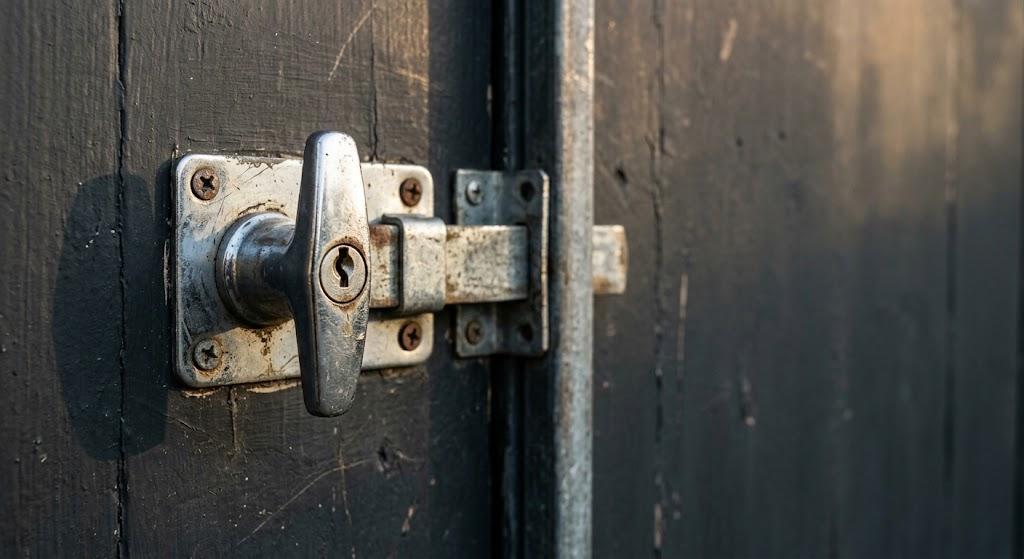
T-handle locks with a cylinder sit in the center of the door and drive two lock bars outward into both tracks at once. These are common on commercial doors and on residential doors without openers, and they are keyed from outside.
Deadbolt-style side locks are a heavier version of the slide lock with a keyed cylinder, giving positive locking that can be operated from outside.
And automatic deadbolt systems are the modern answer for doors with openers. These throw a bolt into the track automatically when the door closes and retract it when the opener runs, giving a positive mechanical lock without the risk of someone forgetting to disengage it.
The Emergency Release Vulnerability
This is the single most important security detail on a garage door and almost nobody knows about it.
Every opener has a manual release, a cord with a red handle hanging from the trolley, which disconnects the door from the opener so it can be lifted by hand during a power outage. On many installations that cord can be reached from outside by pushing a wire or hook through the gap at the top of the door and hooking the handle.
Once the release is pulled, the door lifts freely. No force, no noise, no tools beyond a coat hanger.
The fixes are cheap and effective. A release-cord shield covers the trolley so the handle cannot be hooked. Shortening the cord so it does not hang within reach of the top gap helps. A zip tie through the release mechanism, thin enough to break under a firm pull from inside but resistant to a hook from outside, is the low-cost version. And weatherstripping that closes the gap at the top of the door removes the access entirely.
When to Upgrade the Locking Hardware
Four situations make a genuine lock worthwhile rather than optional.
A garage with no automatic opener at all, where the only thing holding the door down is its own weight.
A property left unoccupied for extended periods, whether a second home, a rental between tenants, or a household that travels frequently. An opener carriage is a poor substitute for a lock over three weeks.
A garage on a side or rear elevation not overlooked from the street, where someone has time and privacy to work.
And a garage storing genuinely valuable contents: tools, equipment, bicycles, or a vehicle worth more than most of the house contents.
In each of those cases a properly specified garage door lock replacement restores positive mechanical locking to the assembly. Installation matters here as much as product choice, because a lock that fouls the door travel or engages while the opener runs will damage the door within weeks.
The Door Into the House
One related item, because it is where a garage break-in usually goes next.
The pedestrian door between the garage and the living space is frequently the least secure door in the house. It is often a hollow-core interior door, fitted with a passage set rather than a lock, and left unlocked because it feels internal.
Functionally it is an exterior door. It should be solid core or fire rated, it should be self-closing, and it should have a deadbolt. This also happens to be a code requirement in most jurisdictions for the fire separation between a garage and living space, so it is worth doing regardless of the security argument.
Get the Door Assessed First
One practical note. Adding locking hardware to a door assumes the door itself is running properly. A door that is noisy, heavy, slow, or closing out of square has a mechanical problem, and fitting a lock to it will make the misalignment worse rather than better.
Sort the mechanism first: springs, cables, rollers and balance. Then add the lock to something that works.