
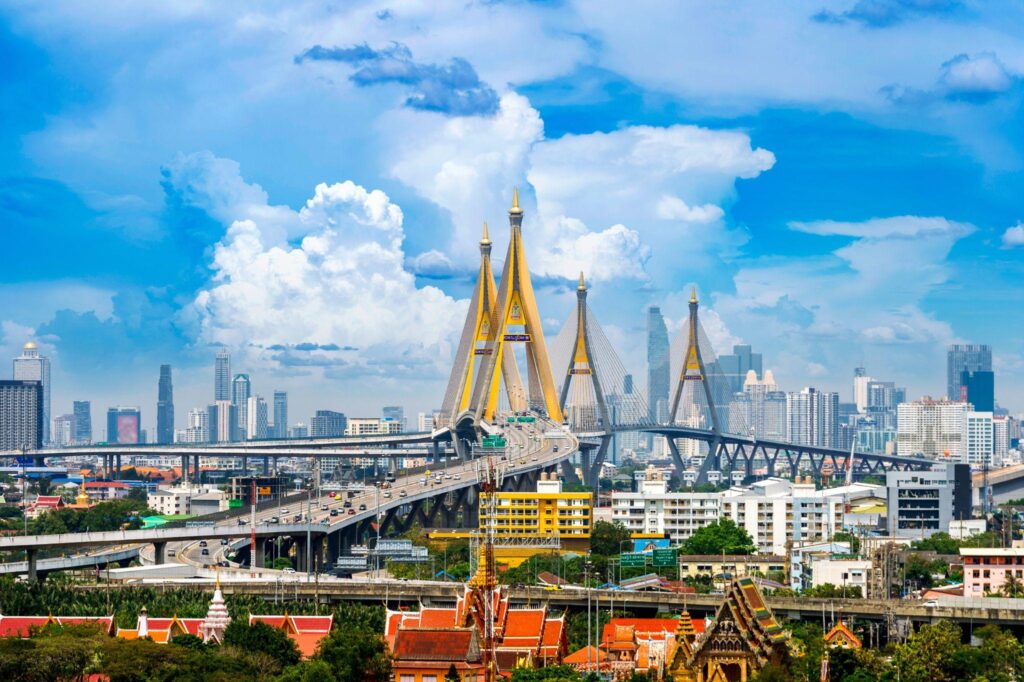
Ultra-prime condominiums in Bangkok are now competing directly with prestigious residences in Singapore, Hong Kong, and Dubai — offering comparable design quality, branded management, and skyline or riverfront views, but at a meaningfully different price point. For buyers weighing luxury real estate across Asia’s major cities, that gap is becoming one of the more compelling arguments for Bangkok’s luxury real estate.
The Price Gap Is Larger Than Most Buyers Expect
Regional pricing data makes the case plainly. Average residential prices in Hong Kong run around $23,255 per square metre, while Singapore averages roughly $17,715 per square metre across all dwelling types. Bangkok’s new mid-tier and luxury apartment segment, by contrast, averages closer to $3,651 per square metre — a fraction of either city, even before accounting for the fact that Bangkok’s true ultra-prime tier commands significantly more.
Even at the very top of Bangkok’s market, where select branded and ultra-luxury developments reach THB 500,000–750,000 per square metre, that still converts to roughly $14,000–21,000 per square metre — below Hong Kong’s citywide residential average and broadly comparable to, or still under, Singapore’s. In practical terms, a buyer can access genuinely world-class branded residences in Bangkok — the kind carrying names like Four Seasons, Mandarin Oriental, or Ritz-Carlton — for a fraction of what equivalent square footage costs in Hong Kong or Singapore’s prime districts.
Space Is Part of the Value Equation
Price per square metre only tells part of the story. Unlike Hong Kong or Singapore, where space is severely constrained and units are typically compact, Bangkok luxury condominiums often offer considerably more expansive layouts for a comparable budget. Luxury buyers moving from Hong Kong or Singapore frequently find that what would be a modest one- or two-bedroom unit at home stretches to a significantly larger footprint in Bangkok — often with the added benefit of larger balconies, more generous common areas, and lower-density buildings, particularly in the city’s newer branded developments.
A Genuinely International Buyer Base
Bangkok’s luxury segment isn’t being carried by any single nationality. Regional Asian purchasers — from Singapore, Hong Kong, Taiwan, Japan, and South Korea — remain highly active buyers in prime Sukhumvit and the central CBD, drawn largely by the comparative affordability of Bangkok stock relative to their home markets. At the same time, Western buyers from the UK, continental Europe, Australia, and the United States have become increasingly visible in the upper tier, often citing the same value gap along with the city’s year-round livability and connectivity.
This diversity matters for resale liquidity. A luxury market dependent on one or two source countries is vulnerable to that country’s economic or regulatory shifts; Bangkok’s broader buyer base — spanning both regional and Western capital — provides a more resilient foundation, particularly in the branded and super-prime segments where global name recognition helps sustain demand regardless of which nationality is buying in a given year.
The Legal Framework Is Comparatively Simple
Part of what makes Bangkok attractive to this international buyer pool is how straightforward the ownership framework actually is relative to the complexity foreign buyers often encounter elsewhere in Asia. Foreign nationals can purchase freehold condominium units under the Condominium Act, subject to a 49% foreign-ownership quota calculated on a per-building basis. That’s a materially simpler proposition than the additional stamp duties, cooling measures, and ownership restrictions foreign buyers face in markets like Singapore and Hong Kong, where non-resident buyers are often subject to substantially higher transaction taxes on top of the purchase price itself.
Yield Is Competitive Too
The value gap isn’t just about entry price — it extends to ongoing returns. Gross rental yields on Bangkok luxury and prime condominiums typically run in the 4–6% range, and in some well-located submarkets closer to the BTS network, yields of 5–7% are achievable. That compares favorably with the compressed yields typically seen in Hong Kong and Singapore’s prime residential markets, where high entry prices generally hold gross yields to the 2–3% range. For income-focused buyers, that difference compounds meaningfully over a holding period.
Reading the Comparison Correctly
None of this means Bangkok is simply “cheaper” in a way that implies lower quality — the branded residences competing at the top of the market carry the same global hospitality names, the same construction standards, and increasingly the same design pedigree as their counterparts in Hong Kong, Singapore, or Dubai. What differs is the underlying cost structure: land, construction, and — critically — regulatory friction. That combination is what allows Bangkok to offer genuinely comparable luxury product at a fundamentally different price basis, and it’s the core reason regional and international capital continues to flow into the city’s top-tier developments even as the broader mass-market condo sector works through its own, separate oversupply challenges.
Working the Comparison in Practice
For buyers actually acting on this thesis, the execution matters as much as the analysis — identifying which specific developments carry genuine brand equity and land scarcity versus which are simply priced at “luxury” without the underlying fundamentals to support it. TYT Asset works with international buyers evaluating Bangkok against other Asian luxury markets, with access to off-market and pre-launch opportunities across the city’s most defensible addresses.
Viewed against Hong Kong, Singapore, or Dubai, Bangkok’s luxury real estate market isn’t a discount alternative — it’s a different cost structure attached to comparable product, and for many international buyers, that distinction is exactly the opportunity.