
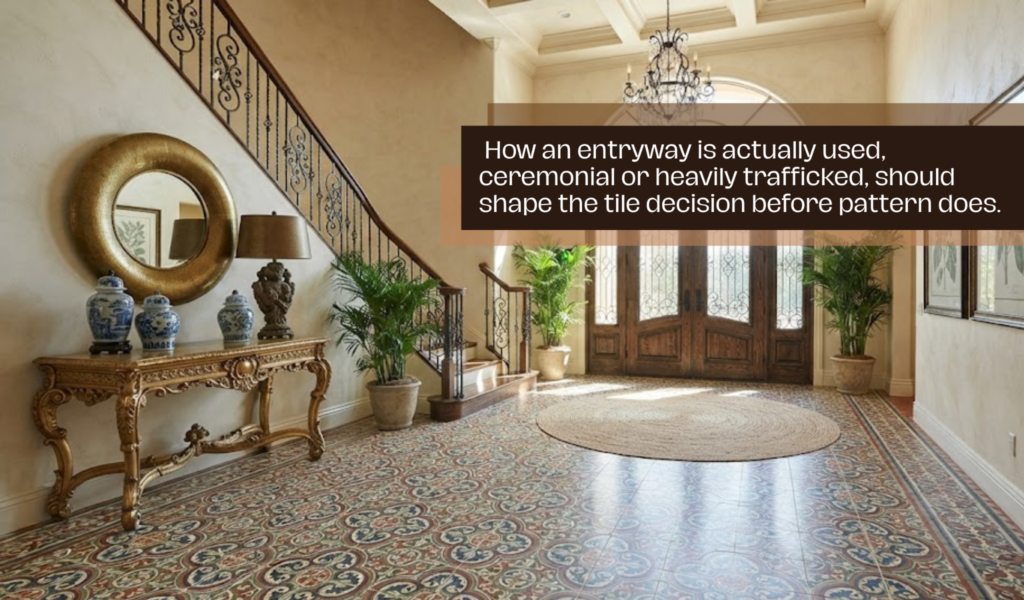
A premium home starts making its case before anyone reaches the living room. The entryway is the first surface a guest actually stands on, and in a house built around considered materials and craftsmanship, a generic floor tile there undercuts everything that comes after it.
Choosing the right entryway tile is less about picking a pretty pattern and more about matching material, scale, and finish to how the space is actually going to live.
This is also one of the few rooms where the design decision and the practical decision are genuinely the same conversation.
A tile that looks right on a moodboard but cannot handle daily foot traffic, weather, or cleaning will end up being replaced within a few years, at which point the “statement” it made was a short-lived one.
The guide below walks through how designers typically approach this decision, from material and pattern down to finish and installation.
Start with how the space will actually be used
Before looking at a single sample, it helps to be honest about traffic.
A grand foyer in a home with a separate mudroom sees a different kind of wear than a single entry that absorbs every muddy boot and delivery box.
High-traffic entries need a tile rated for heavy residential wear, with a body dense enough to resist scratching from tracked-in grit over years of use.
Lower-traffic, more ceremonial entries have more room to prioritize pattern and color over pure durability. This kind of planning is exactly where thinking through the right tile choices for a specific room pays off before a single order is placed.
Choose a material that matches the home’s design language
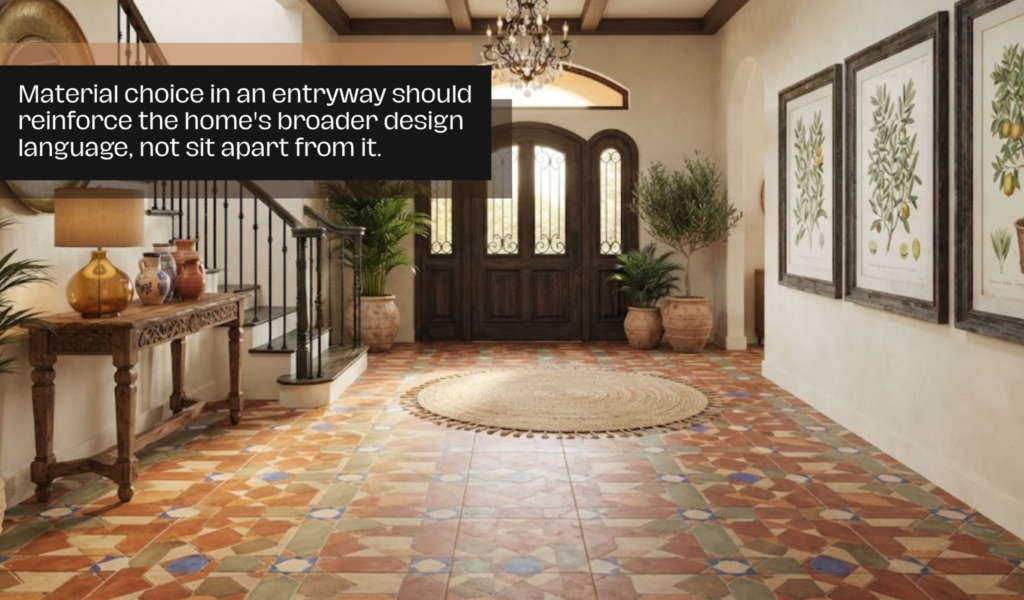
Material is where an entryway either reinforces a home’s overall design language or fights against it.
A Mediterranean or Moroccan-influenced home calls for something with real handmade character, such as clé entryway tile collection. Its unglazed terracotta bejmat and hand-poured encaustic cement both bring genuine warmth and texture, and because the cement’s color runs through the full thickness of the tile rather than sitting on the surface, the pattern holds up under the kind of daily wear an entryway sees.
A more minimalist or Scandinavian-leaning home tends to call for something quieter: a honed natural stone, a large-format porcelain, or a restrained geometric cement pattern in a muted palette. The goal either way is the same.
The entryway tile should be read as a deliberate extension of the home’s material story, not a separate decision made in isolation.
It is worth resisting the temptation to treat the entryway as a blank slate simply because it is a smaller room than the kitchen or primary bath.
Because it is the first material a person encounters, inconsistency here is more noticeable, not less, than it would be in a room seen only after the rest of the home’s language has already been established.
Scale the pattern to the size of the room
A bold, intricate pattern that looks stunning in a photograph can overwhelm a small entry, while an oversized, minimal format can feel cold and characterless in a grand foyer.
As a general rule, smaller entryways benefit from smaller-format tile or a more restrained pattern, since a busy design in a tight space reads as cluttered rather than intentional.
Larger foyers can carry a bolder geometric or floral cement pattern precisely because there is enough floor to let the pattern breathe.
It is also worth considering how the entryway pattern will read from adjoining rooms. An entryway rarely exists in complete visual isolation, so the transition at the threshold matters as much as the pattern itself.
Do not overlook finish and slip resistance
Even in a premium home, an entryway is a functional surface before it is a decorative one.
A glossy, polished finish photographs beautifully but performs poorly the moment weather brings in water or snow, while a honed, matte, or textured finish holds up to both wear and moisture without sacrificing the material’s visual depth.
This is one area where it pays to prioritize function without feeling like a compromise: a well-chosen matte zellige or a honed stone still carries plenty of visual interest without the slip risk of a glossy alternative.
Grout choice deserves the same attention as the tile itself.
A grout color that is too close to white will show tracked-in dirt within days in a well-used entry, while a grout that is too dark can make a light, delicate pattern look muddy.
Testing a small sample board with the actual grout color, rather than relying on a manufacturer’s rendering, avoids a mismatch that only becomes obvious after installation.
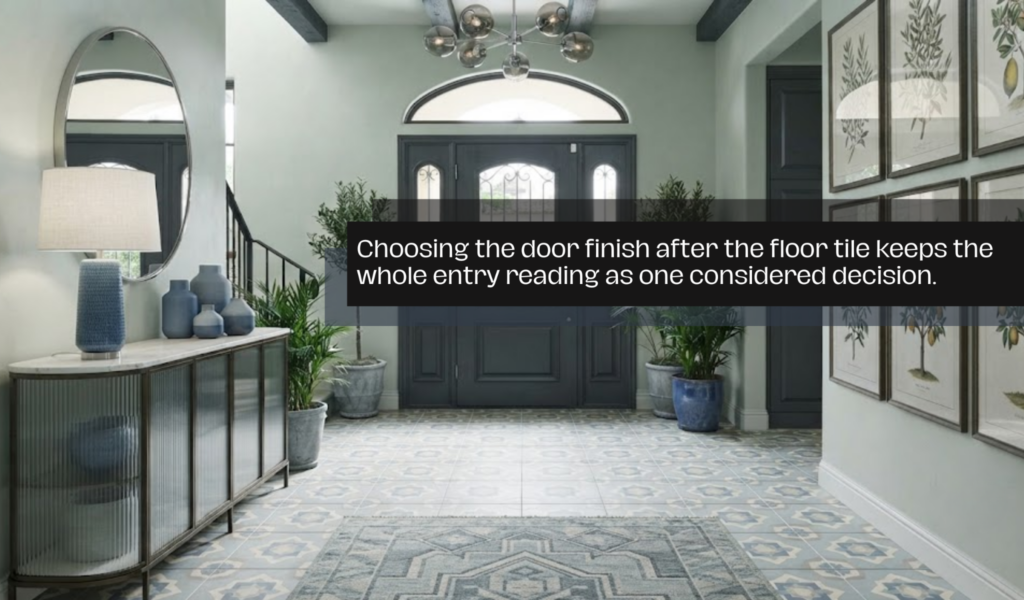
Let the tile set the tone for the doorway itself
An entryway floor does not operate independently from the door, hardware, and trim around it.
The undertones in a tile, warm terracotta, cool grey stone, or a bold cement pattern, should inform decisions about color and finish at the doorway rather than the other way around, since the floor is typically the largest and most fixed material in the space. A front door finished after the tile is chosen tends to read as more cohesive than one selected in isolation.
Working with a designer or installer
Once material and pattern are settled, the specification details matter as much as the aesthetic ones. For a mid-range budget within a premium build, brands provide custom and genuine Moroccan cement patterns at a more accessible price point than some of the higher-end handmade collections.
Whichever brand is ultimately specified, confirm the tile is rated for floor use rather than walls only, request full-size samples before finalizing an order, and ask directly about lead time for any made-to-order or hand-glazed line, since these details are easy to overlook until they threaten a construction schedule.
An experienced installer also matters more here than in almost any other room. A bold pattern or a hand-poured cement floor only looks intentional when the layout is planned to avoid awkward slivers at the doorway and the cuts at the threshold are precise.
None of this needs to feel like a constraint on design ambition.
The entryways that work best in premium homes are the ones where material, pattern, and function were considered together from the start, rather than a beautiful tile chosen first and made to work around everything else.