
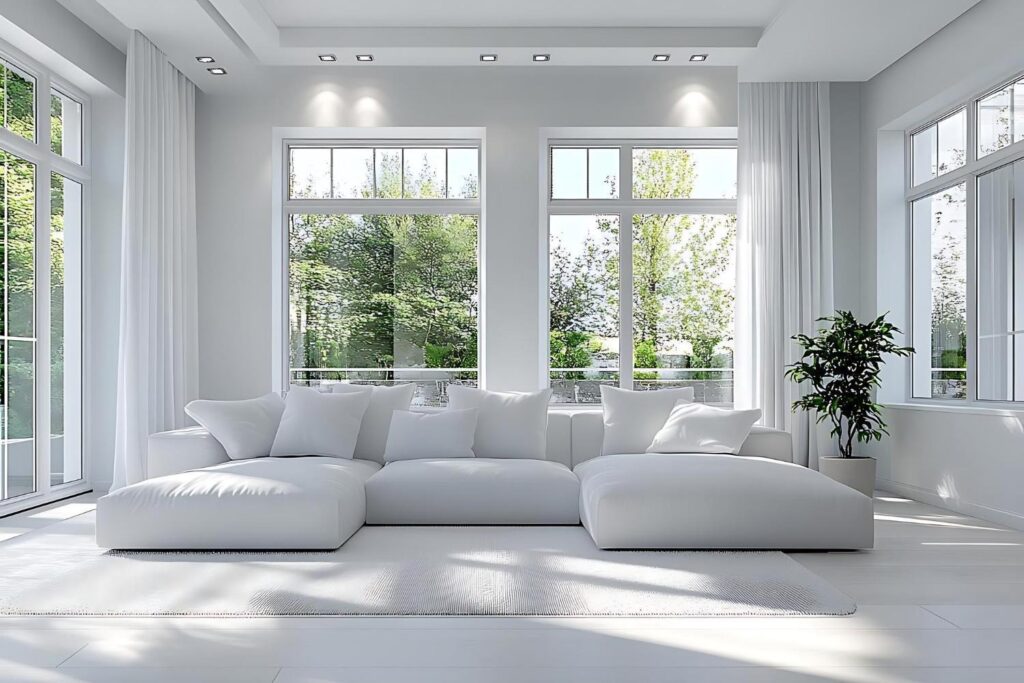
Walk through any beautifully finished interior and count the decisions that were made deliberately. The stone, the joinery, the lighting plan, the hardware, the paint pulled from a dozen samples. Now count the windows. In a striking number of otherwise considered homes, the windows are whatever the builder installed, and every subsequent choice has been made to work around them. It is an odd blind spot, because windows do more to determine how an interior actually feels than almost any furnishing placed within it.
Light Is the Material Everything Else Sits In
Every finish in a room is being seen through the light that room receives, and that light is entirely a function of the openings. A north-facing room receives cool, steady illumination that flatters muted palettes and makes warm woods look somewhat flat. South-facing rooms take strong, shifting light that can wash out subtlety and heat a space uncomfortably. Designers who assess a room’s light before selecting anything else consistently produce interiors that look the way they were intended to, and those who choose finishes from a showroom and hope tend to be surprised on installation day. Working with a window company early, while glazing decisions are still open, gives a project options that simply disappear once the openings are fixed.
Proportion Does More Than Style
The most common window mistake in otherwise expensive homes is scale rather than style. Openings that are too small for a room’s volume make a generous space feel apologetic, and a wall of glass in a room without the ceiling height to carry it looks like a showroom rather than a home. Sightlines matter as much as size, since the width of frames and mullions determines whether a view reads as a picture or as a series of fragments. These are proportional judgments best made against a room’s actual dimensions, not selected from a catalog of options. Placement deserves the same scrutiny. A window centred on a wall for exterior symmetry may sit awkwardly against the furniture arrangement inside, and openings that stop short of a corner can leave a room feeling boxed in where a return of glass would have opened it entirely. Reconciling how a facade reads from the street with how a room works from within is genuinely difficult, and it is the sort of problem far better solved on a drawing than discovered after installation.
Frames Are a Finish, Not Just Hardware
Frame material affects the character of an interior more than most people anticipate. Slim steel or aluminum profiles produce a crisp, contemporary line and maximize glass area. Timber brings warmth and depth and suits traditional interiors, at the cost of more maintenance. Composite and clad systems attempt to combine performance with appearance and vary considerably in how convincingly they manage it. Interior frame color is a design decision in its own right, and treating it as such, rather than defaulting to white because that is what arrived, is one of the easier upgrades available on a renovation.
Performance Is Not the Enemy of Aesthetics
There is an outdated assumption that energy-efficient glazing means compromised appearance, and it has not been true for some time. Modern coatings and multi-pane assemblies deliver substantial performance gains without the heavy tint or bulk that once came with them. Product ratings and their meanings are set out by ENERGY STAR, which explains how factors such as solar heat gain and insulating performance are measured, and understanding those numbers lets a designer make an informed trade rather than an assumption. In practice, better glazing frequently improves an interior, since reduced heat gain means less need for the heavy window treatments that would otherwise be fighting the room’s design. There is a preservation argument as well. Ultraviolet light fades textiles, timber, and artwork over time, and coatings that reduce that transmission protect exactly the furnishings a considered interior has invested in most heavily. Specifying for it is far cheaper than reupholstering a sun-bleached sofa or watching a rug lose its depth along one edge.
Treatments Should Complete a Window, Not Rescue It
Curtains and blinds exist to add texture, control light, and provide privacy, and they perform badly when asked instead to disguise a poorly proportioned or poorly performing window. Planning treatments alongside the glazing rather than afterward changes the details that matter: where a recess sits, whether there is depth for a concealed track, how a stack will fall when a curtain is open. Those provisions are trivial to build in during construction and awkward to retrofit, which is why the most refined installations tend to be the ones where somebody thought about the fabric while the wall was still open.
Screens and the Details Nobody Photographs
The practical accessories attached to windows are where a lot of otherwise careful interiors fall down. Heavy-framed screens can visually divide a view, hardware finishes that were never coordinated introduce a fourth metal into a room that had settled on three, and operable windows chosen without thought to how they open can obstruct a sill you intended to use. Retractable and low-profile screen options exist precisely because these details bother people once they live with them. Specifying them alongside the glazing, rather than accepting whatever comes as standard, is the sort of small decision that separates an interior that looks considered from one that looks nearly finished.