
Somewhere in the past few years, the luxury customer stopped taking the industry at its word. A new kind of craftsman-critic, with an audience in the hundreds of thousands, takes a blade to famous handbags on camera and prices the hide, the hardware, and the hours. The dupe went from guilty secret to a hashtag with billions of views, a generation openly asking what the original charges for beyond the name. The secondhand market, now growing several times faster than the primary one, has made close inspection of stitching, hardware, and hide an ordinary consumer skill. The buyer that luxury now faces arrives informed, and arrives with questions.
The numbers stopped adding up
The questions have teeth because the arithmetic stopped cooperating. In the five years after the pandemic, some flagship bags roughly doubled in price while inflation ran at a fraction of that pace, and bank analysts eventually gave the pattern a name: greedflation. Longtime clients, meanwhile, began cataloging what the increases had not bought, down to hardware descriptions that quietly slid from gold-plated to gold-toned. Court proceedings in Europe went a step further and put the production costs of some famous handbags into the public record, and the distance between the making cost and the ticket price became dinner-table knowledge.
None of this made the customer cynical. It made the customer informed, which is a different thing entirely: bad news for a weak product, and the best news in years for a good one.
The shell’s last costume
Quiet luxury, in its first draft, was the theater’s subtlest act. Take the logo off, soften the palette, keep the price. It photographed as humility and billed as exclusivity, and for a season it worked. But an aesthetic is the easiest thing in fashion to copy, which is precisely what the dupe economy proved, line for line. If the entire proposition is a look, then a copy at a tenth of the price is not an imitation of the product; functionally, it is the product. The aware buyer worked that out quickly.
What survives the teardown video, the resale inspection, and the public production invoice is not a look. It is what the look was always supposed to stand for: craft that can be verified, and heritage that can be traced. Quiet luxury is not dying; it is growing up, from shell to essence, from looks alone to looks backed by making, from a price that performs to a price that can be explained.
What the examined object must answer
The examined object has to answer questions the theatrical one never faced. What is the leather, and how was it tanned: in hours, with industrial chemistry, or across weeks, in wooden drums, the way the best hides have always been made? Where does the material end: in a painted edge, a pigment film that will one day crack and lift, or in an edge turned back over itself, so only leather meets the eye and the fingertip? Who made it, and how long did that hand take to train? What happens to the surface in year ten: does it deepen and burnish into patina, or does a sealed coating simply wear through? And what will the maker put in writing about the decades ahead?
None of this requires expertise, which is the point. A folded edge is visible in any honest product photograph. A tannage is a fact a house either publishes or avoids. Training time is a number. A warranty has a length. The new buyer is not asking for poetry; the new buyer is asking for the specification behind the poetry, and the houses that flinch at the question are answering it.
A house built to be looked at closely
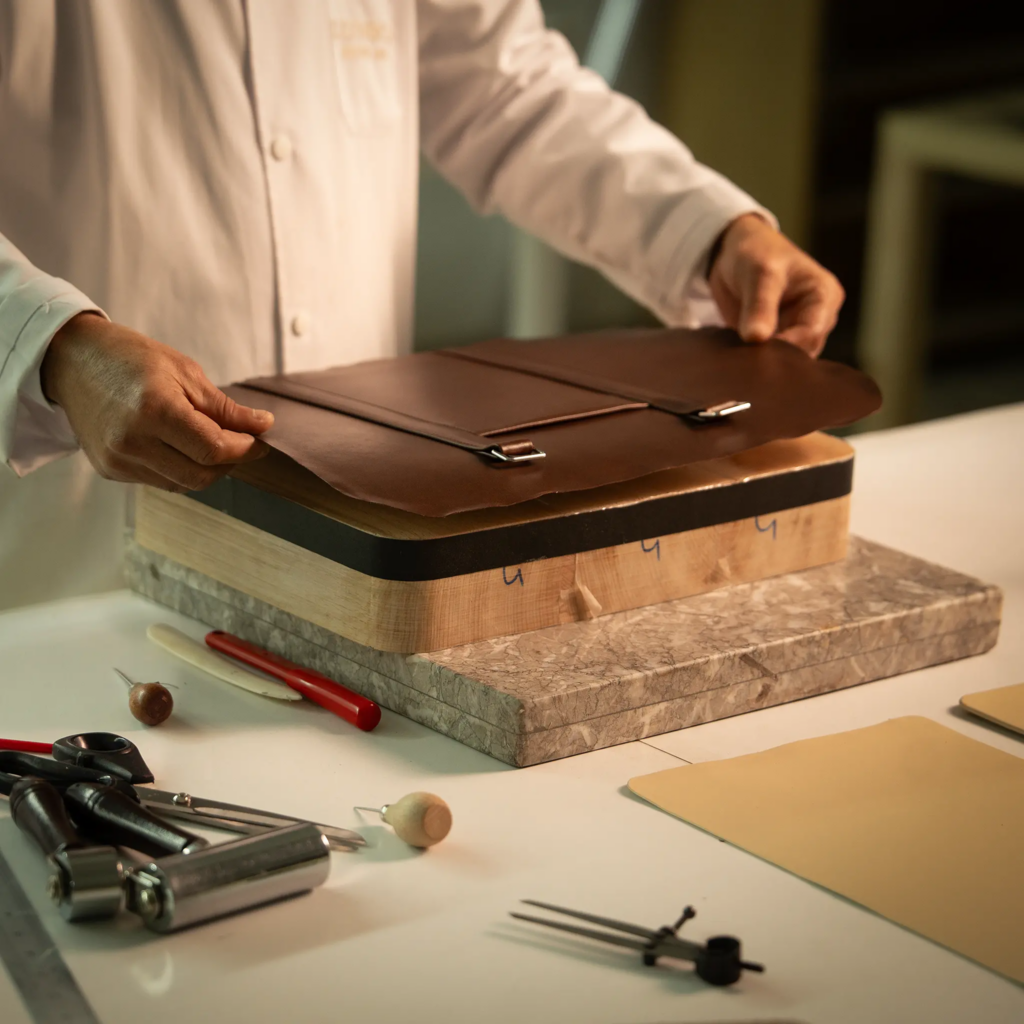
Houses built for this buyer already exist. Lunburg, a young maison with Dutch roots and an atelier in Fes, reads like a bet that the examined object wins. Its leather is vegetable-tanned in Tuscany over forty days in wooden drums. Its edges are finished in rempliage, the folded edge that Fes refined across a millennium, a technique that survives on fewer than one leather good in ten thousand and takes decades of a working life to master. Its pieces carry no logo on the outside, and every one of them is guaranteed for fifty years.
There is also no mystery in the price. Folding an edge by hand consumes ten times the hours that painting one does; a forty-day tannage costs what forty days cost; a fifty-year guarantee is priced into the object it protects. That is what justified pricing looks like: not cheaper, but accountable. The pitch is no longer take our word for it. The pitch is look closer.
Essence compounds
For the home, the consequence is a quieter kind of curation. The examined object earns its place in a room: the briefcase by the door, the folio on the desk, the small leather case that migrates from shelf to pocket, each chosen because it answered the questions and each aging into the interior rather than out of it. An unsealed, slow-tanned surface deepens with sunlight and handling until the object carries the record of its own use, which is a form of decoration no showroom can sell.
Theatrics date. Essence compounds. The look still matters, but it is no longer the argument; it is the introduction to one. And the houses that will define the next decade of quiet luxury are the ones that could watch their own teardown with composure.