
In the high-end interior design industry, the final product is an illusion of effortless perfection. When a luxury design firm unveils a newly renovated heritage home in London’s historic Old North, or a sprawling, ultra-modern executive penthouse overlooking the Thames River, the client sees only aesthetic harmony. They see the flawless installation of bespoke lighting fixtures, the seamless integration of heavy Calacatta marble countertops, and the impeccable curation of custom textiles. What the client does not see—and what the industry frequently attempts to hide—is the intensely physical, chaotic, and hazardous reality required to bring that vision to life. As the busy spring renovation season of May 2026 sweeps through London, Ontario, the city’s top-tier design professionals are coming to a stark realization. The ultimate hallmark of a world-class luxury studio is not just an award-winning portfolio or an exclusive European supplier list. True professionalism requires absolute control over the physical environment, and that includes the biological safety of the team. Today, London’s elite interior design studios are making comprehensive workplace first aid and CPR certification a non-negotiable operational standard, proving that protecting human capital is the highest form of luxury.
The Hidden Physical Toll of High-End Design
There is a pervasive, highly sanitized stereotype that interior design consists exclusively of selecting fabric swatches in pristine, well-lit studios or presenting digital 3D renderings over artisanal coffee. While the conceptual phase certainly involves these elements, the execution phase of a luxury project is, fundamentally, a high-stress construction operation.
When a design team transitions from the studio to the active job site, the biological risk profile skyrockets. London, Ontario, features a dense mix of mid-century suburban builds, towering new downtown condominiums, and century-old heritage properties in neighborhoods like Woodfield and Wortley Village. Working in these varied environments exposes design professionals to severe physical hazards on a daily basis:
- Active Construction Zones: Designers frequently conduct site visits and measurements while general contractors are actively demolishing walls, framing rooms, and running high-voltage electrical lines. Unfinished floors, exposed nails, and falling debris pose constant laceration and puncture risks.
- Heavy Material Handling: Luxury design relies on substantial, weighty materials. Staging a home involves maneuvering solid raw oak dining tables, maneuvering 500-pound slabs of natural stone, and positioning massive, fragile panes of architectural glass. A single slip during a staging day can result in severe crush injuries or catastrophic arterial hemorrhaging.
- Environmental and Electrical Hazards: Renovating older properties in London often means navigating outdated electrical systems, toxic dust, and poor ventilation. The risk of severe electrical shock during lighting placements or sudden respiratory crises is a statistical reality.
- The Physiological Pressure Cooker: The luxury market is defined by demanding, high-net-worth clients, uncompromising deadlines, and massive financial budgets. The chronic stress, sleep deprivation, and intense adrenaline of a “reveal day” significantly elevate the risk of sudden cardiovascular events and panic attacks among the design team.
When a severe physical accident or a sudden medical crisis occurs on-site, the curated aesthetics of the room instantly dissolve. If a senior designer suffers a sudden cardiac arrest while climbing the stairs of a three-story Victorian renovation, or a staging assistant sustains a deep laceration from shattered glass, the only asset that holds any value is the mechanical, offline competence of the people standing in the room.
The “Golden Window” and London’s Geographic Reality
The most dangerous assumption a design firm principal can make is that dialing 911 instantly neutralizes an on-site medical emergency. While the paramedics of Middlesex-London Emergency Medical Services (EMS) are exceptionally trained professionals, they cannot magically bend the laws of urban geography and biology.
In emergency medicine, the timeline for human survival is unforgivingly strict. If a member of your team suffers a Sudden Cardiac Arrest (SCA)—a catastrophic electrical misfire that causes the heart to stop pumping oxygenated blood—the first four to six minutes following the collapse are medically defined as the “Golden Window.” If the brain is completely deprived of oxygen beyond this tiny, rapidly shrinking window, irreversible cellular death and permanent neurological damage begin.
Now, calculate the brutal logistics of an emergency response in London, Ontario. Imagine an incident occurring at a sprawling estate renovation in Sunningdale or deep within a high-rise condominium project near Richmond Row during afternoon traffic. An incoming ambulance must battle city gridlock, navigate confusing detours around endless summer road construction, and locate the specific address. Once they arrive, paramedics must push hundreds of pounds of heavy trauma gear past contractor vehicles, through active construction zones, and up temporary stairwells to reach the patient.
[Medical Crisis on Job Site] ➔ [4-6 Minute Golden Window] ➔ [Paramedics Battling Logistics]
│
Time Expires: Brain Hypoxia Begins Without Immediate CPR
Expecting an external medical team to breach that four-minute window is a massive, dangerous gamble. You cannot outsource those critical first few minutes to the city dispatch. The designers, project managers, and contractors who are already standing in the room must act as the immediate, manual biological failover system.
This stark reality is exactly why elite firms are actively mandating workplace first aid training London for their entire staff. By interlocking their hands and delivering deep, continuous chest compressions, a trained designer acts as a manual, mechanical pump for their fallen colleague. They physically force residual oxygenated blood up into the brain, keeping the neural pathways viable and maintaining the heart in a “shockable” state until advanced medical hardware arrives on the scene.
The Legal Framework: WSIB Compliance in the Creative Sector
Beyond the profound moral imperative of protecting your colleagues and your team, there is a strict, unyielding legal reckoning occurring across Ontario’s creative and design sectors. Many boutique design studios operate under the dangerous misconception that occupational health and safety regulations only apply to heavy industrial manufacturing or large-scale general contracting firms.
This is unequivocally false. Under the Ontario Workplace Safety and Insurance Board (WSIB) Regulation 1101, every single employer covered by the act is legally mandated to provide a safe working environment. This explicitly requires having a fully stocked, legally compliant first aid kit and a designated, mathematically proportionate number of certified first aiders on-site during all working hours. This law applies just as strictly to an elegant, five-person luxury design studio in downtown London as it does to an automotive assembly plant.
Plaintiff attorneys and provincial compliance officers are increasingly scrutinizing the immediate medical response to workplace emergencies. If a contractor or an employee suffers a severe medical crisis on a job site managed by your design firm, and an investigation reveals that your team was completely untrained—resulting in a chaotic, delayed response that exacerbated the injury or led to a wrongful death—the firm exposes itself to devastating legal consequences.
The financial penalties, the potential for immediate stop-work orders, and the catastrophic public relations fallout from a mismanaged emergency can instantly destroy a high-end brand’s reputation. When a studio principal invests in comprehensive safety training for their staff, they are executing the ultimate defensive corporate strategy. They establish a highly documented, legally defensible baseline of care that shields the corporation from negligence lawsuits and proves they meet the highest regulatory standards in the province.
The Luxury of Absolute Control: Client Perception
In the luxury market, your clients are paying for far more than just beautiful furniture and harmonious color palettes; they are paying for absolute peace of mind. High-net-worth individuals, busy executives, and prominent London families hire elite design firms because they want the entire renovation process to be seamlessly managed, insulated from risk, and flawlessly executed.
When you demonstrate to your clients that your firm’s commitment to excellence extends to the physical safety of the job site, you elevate your brand into an entirely different echelon of professionalism.
Imagine a client walking onto an active staging site and seeing that alongside the meticulously organized floor plans and material samples, the lead designer has a standardized first aid kit and an Automated External Defibrillator (AED) on hand. Imagine communicating in your initial client onboarding packet that every single project manager and designer on your team is fully certified in Standard First Aid and CPR Level C.
This level of visible, proactive risk management builds immense psychological safety and trust. It signals to the client that your firm is not just a group of aesthetic decorators, but a highly disciplined, elite operational team capable of managing every conceivable variable of the project. In a highly competitive luxury market, this is a profound brand differentiator.
Demystifying the Automated External Defibrillator (AED)
If there is any demographic that appreciates the intersection of elegant design and complex functionality, it is the interior design community. Yet, the Automated External Defibrillator (AED)—the most vital, life-saving piece of technology that should be present in every design studio and transported to every major installation site—is frequently viewed with deep intimidation.
There is a lingering, irrational fear among the general public that operating an AED requires a medical degree, or that an untrained designer might accidentally deliver a lethal electrical shock to a colleague who has simply fainted from exhaustion or low blood sugar. In 2026, modern AEDs are complete marvels of consumer medical technology, explicitly engineered to be foolproof for the untrained layperson.
The moment you pull an AED from its case and power it on, a loud, calm, AI-driven voice interface takes complete command of the chaotic scene. It instructs the user exactly where to place the adhesive electrode pads on the patient’s bare chest. The machine’s internal software then runs an instant, real-time electrocardiogram (ECG) to analyze the heart’s electrical rhythm. The software is hardcoded to execute a strict binary decision: it will physically lock out the shock function unless it definitively detects a fatal, chaotic arrhythmia like Ventricular Fibrillation.
It is technologically impossible to make a diagnostic error or cause undue harm. However, the hardware requires a human operator with the physical confidence and composure to deploy it during a moment of sheer terror. Comprehensive first aid and CPR certification strips away this hesitation. It provides designers with the hands-on practice needed to confidently tear open the AED case, apply the pads, and seamlessly pair the device’s automated prompts with high-quality, continuous CPR.
Agile EdTech: The Blended Learning Solution for the Busy Designer
Historically, the single biggest hurdle preventing design firms from comprehensively certifying their teams was the massive loss of billable hours. The interior design industry is notorious for its relentless schedules, endless client meetings, and strict installation deadlines. Asking an entire studio of high-performing creative professionals to abandon their workflows for two entire days to sit in a stagnant, brightly lit classroom was an operational impossibility.
In 2026, the safety training industry has brilliantly adapted to the realities of the creative calendar through the widespread implementation of the “Blended Learning” model. This approach is the Educational Technology (EdTech) equivalent of agile project management, perfectly suited for the chaotic, highly mobile lifestyle of the modern design professional.
Instead of losing two days, participants can now complete the heavy cognitive load of the course entirely online via an intuitive, beautifully designed, mobile-optimized Learning Management System (LMS). A designer can watch high-definition instructional videos on severe wound management, complete interactive quizzes on identifying the early warning signs of a stroke, and read up on the physiology of the cardiovascular system directly from their iPad while waiting for a client at a tile showroom, or late at night after finalizing a 3D render.
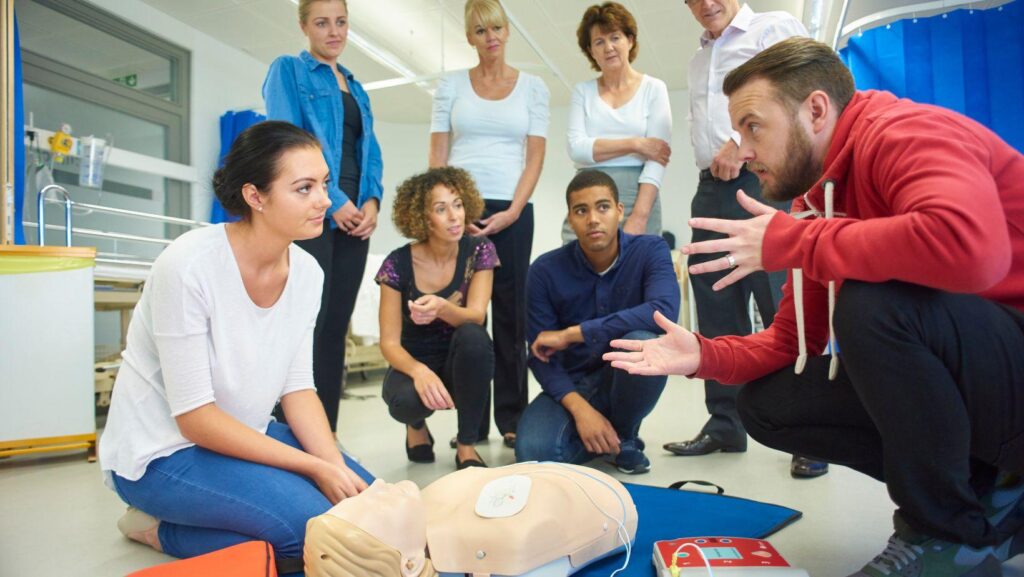
Once the asynchronous digital theory is successfully completed, the design team only needs to attend a highly condensed, single in-person session at a modern training facility in London. This physical session skips the boring lectures and focuses entirely on hands-on physical application. Guided by expert instructors, participants practice deep chest compressions on Bluetooth-enabled smart manikins that provide real-time digital feedback on compression depth, speed, and full chest recoil. They rehearse deploying AED trainers and applying medical-grade tourniquets in simulated environments.
This highly efficient, data-driven educational model allows London’s luxury design studios to rapidly upskill their human capital, achieve full WSIB compliance, and secure their liability shields without disrupting the relentless, demanding pace of their business.
Conclusion: The Architecture of Survival
The foundation of every magnificent, beautifully designed space is the invisible structural engineering that holds the building together. In the business of luxury interior design, your team is that foundational structure. You can source the rarest Italian marble, import the finest French textiles, and design the most breathtaking architectural layouts, but if the human beings executing your vision are not protected, the entire enterprise is structurally unsound.
The era of the purely aesthetic, risk-blind design firm is over. The modern luxury standard demands extreme ownership over the physical environment. By investing the time to become comprehensively certified in first aid and CPR, London’s design professionals are proving that their commitment to excellence goes far beyond the surface. Ensure that when the unpredictable happens on your job site or in your studio, your team has the mechanical skills, the legal protection, and the unshakeable confidence to step forward and save a life. That is the true art of design.
Frequently Asked Questions for Design Professionals
1. Is a boutique interior design studio with only three employees legally required to have a trained first aider in Ontario? Yes, absolutely. This is a very common misconception among small creative agencies. Under the Ontario Workplace Safety and Insurance Act (WSIB Regulation 1101), all employers, regardless of size, must provide compliant first aid equipment and trained personnel. For a small studio with 1 to 5 employees per shift, you are legally mandated to have at least one worker holding a valid Emergency First Aid certificate present at all times.
2. Does a standard first aid course cover severe physical trauma like amputations or arterial bleeding from power tools? Yes. Because interior designers frequently work on or near active construction sites, understanding major trauma is critical. A comprehensive Standard First Aid program covers advanced wound management, including the proper application of firm, direct pressure, how to pack a deep puncture wound, the correct use of a medical-grade tourniquet for catastrophic arterial bleeding, and how to safely preserve an amputated digit for surgical reattachment.
3. Are design professionals protected from civil lawsuits if they break a contractor’s rib while performing CPR on a job site? Yes. The fear of litigation often paralyzes bystanders, but it is completely unfounded under provincial law. Ontario’s Good Samaritan Act, 2001 provides absolute, robust civil liability protection to any individual who voluntarily provides emergency medical assistance at the scene of an accident in good faith. As long as the designer acts without gross negligence and stays within the general scope of their training, they are legally shielded from civil liability for accidental injuries—such as a broken rib, which is a common consequence of delivering effective chest compressions.
4. Can an AED be safely used in a dusty, active construction environment or an unfinished basement? Yes. Modern AEDs are highly durable and designed to operate in complex, real-world environments. However, safety training teaches you specific environmental precautions. For example, if the patient is lying in a pool of water (such as near an unfinished plumbing line), you must safely drag them to a dry area and wipe their chest dry before applying the electrode pads, as water is highly conductive and can cause the electrical shock to arc across the skin rather than penetrating the heart muscle.
5. Are fully online CPR certificates valid for WSIB compliance audits for my design firm? No. This is a critical compliance trap that studio principals must avoid. While fully online courses provide excellent baseline theoretical knowledge, the WSIB strictly mandates a practical, hands-on physical assessment to issue a valid, legally compliant workplace safety certificate. The Blended Learning model is fully compliant because it seamlessly pairs the flexible online cognitive modules with a mandatory, in-person physical skills test evaluated by a certified Red Cross or Lifesaving Society instructor.