
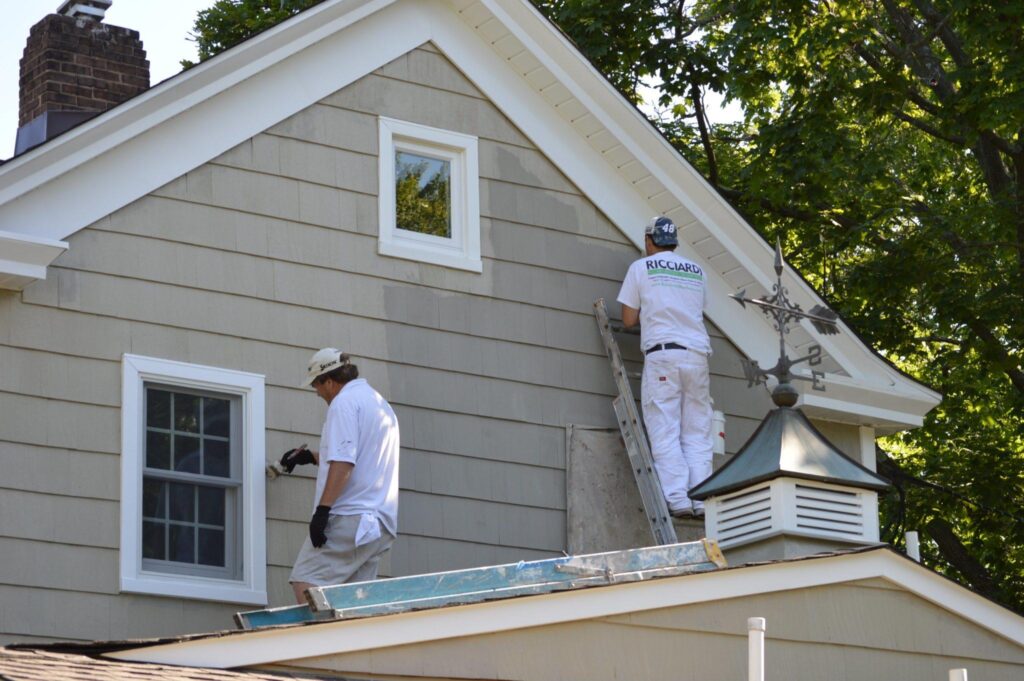
Most homeowners who book exterior painting services expect to pay for paint and labour, and are surprised when the quote comes back higher than that mental math suggested.
The gap between expectation and reality is not a pricing problem. It is an information problem. When you understand what a professional exterior paint job actually involves from start to finish, the numbers make sense. More than that, you start to see why cutting costs in the wrong places leads directly to peeling paint, early failure, and a redo job two or three years down the road.
This article breaks down what you are genuinely paying for when you hire a professional crew and what distinguishes a thorough service from one that looks fine on day one but falls apart by year two.
What Exterior Painting Services Actually Cover
The phrase “exterior painting services” sounds simple. In practice, it describes a multi-phase process that involves assessment, repair, preparation, priming, coating, and quality control, all before the job is considered complete.
Here is what a full-scope professional service typically includes:
Site assessment and consultation. Before any work is quoted or scheduled, a professional crew walks the property and evaluates every surface that will be painted. They look at the condition of existing coatings, identify damage or deterioration that needs addressing, and flag any access challenges that affect how the job will be approached.
Surface preparation. This is the phase that consumes the most time and has the greatest impact on how long the finished job lasts. It includes pressure washing, scraping, sanding, spot priming, caulking, and minor repairs. On a typical home, preparation takes one to two full days before any topcoat goes on.
Priming. Bare wood, repaired areas, and surfaces with adhesion concerns all require primer before topcoat. Skipping primer on those surfaces is one of the most common shortcuts that leads to early paint failure.
Topcoat application. This is the visible part of the job, the actual painting. Professional crews use a combination of spraying, back-rolling, and brushwork depending on the surface type and location. Two coats of topcoat are standard on a proper repaint.
Cleanup and final walkthrough. A professional service ends with the property left clean, all masking removed, and a walkthrough with the homeowner to confirm every surface meets the agreed standard.
Each of these phases has a real cost attached to it. When a quote seems unusually low, it is almost always because one or more of these phases has been reduced or removed entirely.
The Preparation Phase: Where Most of the Value Lives
If there is one thing worth understanding about exterior painting services, it is this: the preparation phase determines the outcome far more than the paint brand, the application method, or the number of crew members on the job.
A properly prepared surface gives paint something solid to bond to. A surface with loose, chalking, or peeling existing paint, or one that has not been cleaned thoroughly, gives the new coating nowhere stable to grip. No matter how good the product is, it will fail faster on a compromised surface.
What thorough preparation looks like in practice:
Pressure washing removes years of accumulated dirt, mould, mildew, and oxidized paint. It also reveals the true condition of the surface underneath, damage that was hidden by grime becomes visible and can be addressed before painting begins.
Scraping removes any paint that has lost adhesion to the substrate. This step cannot be rushed. Painting over loose paint does not stabilize it; it just delays the failure by one season.
Sanding smooths the edges of scraped areas so the new coating transitions evenly without visible ridges in the finished surface.
Caulking seals every gap where water can penetrate – around window frames, door casings, trim joints, and any penetration in the wall. Water infiltration is the leading cause of exterior paint failure, and caulking is the primary defence against it.
Wood repair addresses any soft spots, rot, or physical damage found during preparation. Minor repairs are handled on-site. Significant structural issues get flagged for the homeowner before painting proceeds.
Crews that skip or rush these steps are not providing a discount; they are providing a shorter lifespan. The math on that trade-off never favours the homeowner.
How Product Selection Affects Long-Term Performance
Not all exterior paints perform equally, and the product choice made by your painting crew affects how long the job holds up as much as any other single factor.
Professional-grade exterior coatings are formulated differently from the products available at general hardware stores. They contain higher concentrations of binders, the component that holds pigment to the surface and gives the film its flexibility and durability. That higher binder content is what allows professional-grade paint to expand and contract with temperature changes without cracking and to resist moisture infiltration over years of weather exposure.
A few product considerations worth understanding before you hire:
Acrylic latex versus alkyd. For most exterior surfaces in variable climates, 100% acrylic latex is the practical choice. It stays flexible across temperature ranges, dries faster, and resists moisture better than alkyd-based coatings. Alkyds have their place on specific surfaces like bare metal trim, but they are less suited to broad exterior applications in freeze-thaw climates.
Sheen level. Higher sheen finishes, satin and semi-gloss, are more moisture-resistant and easier to clean. They work well on trim, doors, and high-contact surfaces. Flat or low-sheen finishes hide surface imperfections better and are often used on broad siding areas where texture variation would otherwise show.
Primer compatibility. The primer and topcoat should be from the same product system wherever possible. Mismatched primer and topcoat formulations can cause adhesion problems even when both products are individually high quality.
When reviewing quotes, ask specifically what products will be used, brand name and product line, not just “quality exterior paint.” If a contractor cannot answer that question specifically, that tells you something about how seriously they approach the technical side of the work.
What Climate Does to Exterior Paint Over Time
Exterior coatings do not age in a controlled environment. They age through seasons – through freeze-thaw cycles, UV exposure, driving rain, temperature swings, and biological growth from mould and algae. Understanding what your local climate does to paint helps you make smarter decisions about product selection, timing, and maintenance.
In cold climates with significant winter freeze-thaw cycling, paint films that are too rigid tend to crack as surfaces expand and contract. In hot, high-UV environments, pigment breakdown and binder oxidation cause chalking and fading faster than in moderate climates. In humid regions, moisture management – through proper caulking, priming, and vapour-permeable coatings – becomes the central concern.
Wherever you are located, the best exterior painting services adapt their process and product choices to local conditions, not just to what is on sale or what they have always used.
Timing: Why Scheduling Matters More Than Most People Realize
The timing of an exterior paint job affects how the coating cures, how well it bonds, and ultimately how long it lasts. This is not a minor detail. it is a factor that professional crews take seriously and plan around carefully.
Most exterior coatings require application temperatures between 10°C and 30°C (50°F to 86°F). Outside that range, the paint film does not form correctly. Applied in heat above that window, the paint dries too fast and traps solvents, leading to blistering. Applied too close to freezing, it loses adhesion and may never cure properly.
Beyond temperature, experienced crews also monitor:
- Dew point. High ambient humidity – even on a warm, sunny day – can cause adhesion problems if moisture is condensing on surfaces. Morning starts are often delayed on high-dew-point days until surfaces have dried out.
- Rain windows. Paint needs at least 48 hours without rain after application to cure properly. Professional crews check extended forecasts, not just same-day weather.
- Sun position. Painting a surface in direct, intense afternoon sun causes the film to skin over before solvents escape, trapping them underneath and causing blistering. Experienced crews follow the shade around the house throughout the day.
Late spring and early fall offer the most reliable conditions in most of Canada and the northern United States. That said, good crews plan around actual forecast data, not just the calendar.
How to Evaluate Whether You Received Quality Service
Once the job is done, you deserve a finished product you can assess with confidence. Here is what to look for during the final walkthrough:
- Coverage consistency. No thin spots, missed areas, or visible streaks in the finished surface.
- Clean edges. Crisp lines where paint meets trim, window frames, and doors – no bleeding or ragged transitions.
- No overspray. Windows, concrete, plants, and any adjacent surfaces should be clean and free of paint mist.
- Uniform sheen. The finished surface should look consistent in all lighting conditions, with no patchy or uneven areas.
- Caulking quality. All caulked joints should be smooth, fully adhered, and painted over cleanly.
Do not rush this walkthrough. Check the work from different angles and in different lighting. A professional crew that stands behind their work will address any legitimate concern on the spot or return to correct it promptly. If a contractor resists a walkthrough or becomes defensive about questions, that resistance tells you something important.
Getting the Most From Exterior Painting Services Long Term
A well-executed exterior paint job should last eight to twelve years in most climates before a full repaint is needed. Getting that lifespan out of the work is not just about hiring the right crew, it also involves basic maintenance during those years.
Keep gutters clear so water does not back up and run down painted siding. Wash the exterior every one to two years to remove biological growth before it damages the coating. Touch up any chips or cracks as they appear rather than letting moisture get behind the paint film.
Exterior painting services are an investment in your home’s protection, not just its appearance. When the work is done properly – with real preparation, quality products, and a crew that understands your local conditions – that investment pays back in years of reliable performance and curb appeal that holds up through every season.
Choose carefully, ask good questions, and do not settle for a crew that cannot explain every step of their process.