
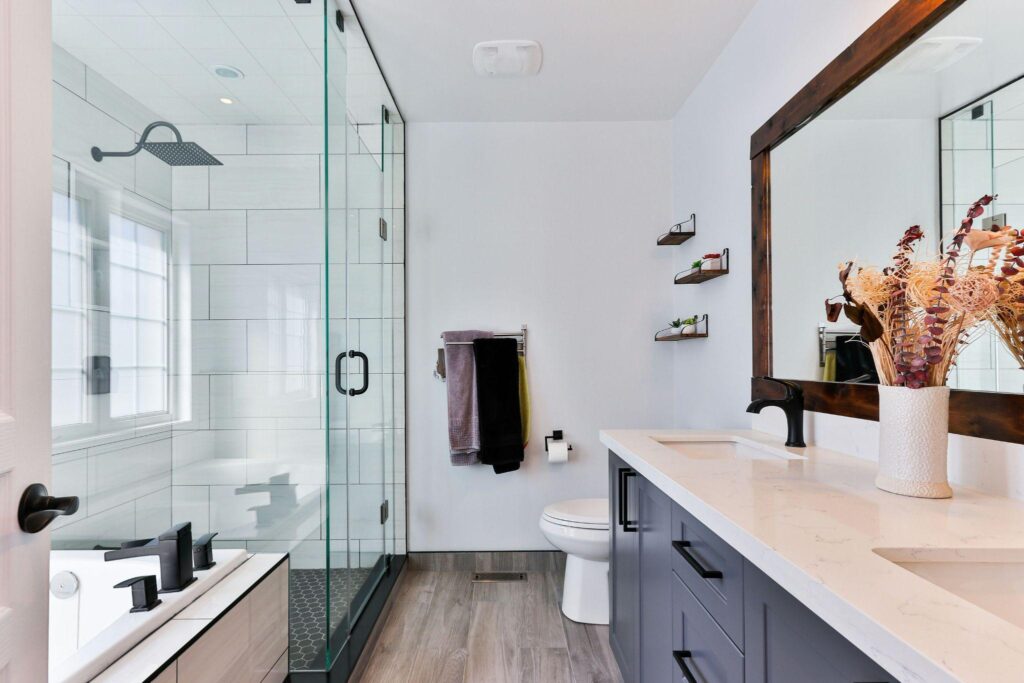
The bathroom has undergone a quiet transformation over the past several years. What was once treated as a purely functional space has become one of the most considered rooms in the home, a place where design ambition, material quality, and personal comfort are expected to converge at the highest level. In 2026, luxury bathroom design is defined less by opulence for its own sake and more by a refined understanding of how a space should feel and perform every day.
Whether you are planning a complete renovation or a targeted upgrade, knowing which features define the leading edge of bathroom design right now helps you make decisions that hold their value aesthetically and financially over time.
The Move Toward Spa-Calibre Experiences at Home
The clearest trend running through luxury bathroom design in 2026 is the sustained demand for at-home spa experiences. This is not a new direction, but it has matured considerably. Homeowners are no longer satisfied with a rainfall shower head and a freestanding tub as markers of luxury. The expectation now is for a genuinely immersive environment that functions as well as it photographs.
Steam Showers and Thermostatic Systems
Steam enclosures have moved from a hotel amenity to a residential expectation in the top tier of bathroom renovation. The key difference between a functional steam shower and a genuinely luxurious one lies in the controls and the spatial design. Thermostatic systems that allow precise temperature regulation, timed sessions, and integrated chromotherapy or aromatherapy elements are now widely available at residential scale.
The enclosure itself matters as much as the system. Floor-to-ceiling large-format tiles with minimal grout lines, integrated niches with concealed lighting, and linear drains that disappear into the floor surface all contribute to the seamless quality that defines this category.
Heated Floors and Surfaces
Radiant floor heating has been standard practice in high-end bathrooms for years, but the application has expanded. Heated towel rails have given way to full wall-panel heating systems in some installations. Heated mirrors that eliminate condensation are now a baseline expectation rather than a feature. These are the details that separate a bathroom that looks luxurious from one that feels luxurious at six in the morning.
Material Choices That Define the 2026 Aesthetic
Materials set the tone of a bathroom more decisively than any other design element. In 2026, the dominant aesthetic moves away from high-gloss surfaces and toward materials with texture, depth, and organic variation.
Natural Stone and Bookmatched Slabs
Marble has never left luxury bathroom design, but the way it is being used has shifted. Bookmatched slabs, where adjacent cuts of stone are mirrored to create a symmetrical pattern, are appearing across feature walls, shower enclosures, and vanity surrounds. The effect is architectural in scale and unmistakably bespoke.
Quartzite, travertine, and unlacquered stone finishes are gaining ground over polished marble, particularly in bathrooms that favour a warmer, more textured character. The patina that develops on unlacquered natural stone over time is increasingly understood as a design asset rather than a maintenance burden.
Fluted and Reeded Surfaces
Fluted detailing, vertical grooves applied to cabinetry, stone, and ceramic surfaces, has become one of the defining textural moves of the current period. It appears on vanity fronts, bath panels, and decorative wall tiles, adding dimensionality to surfaces that would otherwise read as flat. The play of light across a fluted surface changes through the day in ways that solid planes cannot replicate.
Dark and Moody Palettes
The all-white bathroom is not disappearing, but the most interesting spaces in 2026 are exploring richer territory. Deep greens, charcoal, slate blue, and warm blacks are being used across floors, walls, and cabinetry to create bathrooms that feel genuinely enveloping. When executed with the right lighting and material combinations, a dark bathroom reads as sophisticated and calm rather than heavy.
Vanity and Storage Design
Floating Vanities and Integrated Storage
The floating vanity continues to dominate because it serves both aesthetic and practical purposes: it makes a bathroom feel larger, simplifies cleaning, and allows for under-vanity lighting that adds warmth to the floor plane. In 2026, the design emphasis is on deep drawers with custom organisation inserts, soft-close mechanisms, and handle-free fronts that maintain a clean profile.
Integrated storage, cabinetry that disappears into the wall plane, is appearing more frequently in primary bathrooms where the budget allows for the additional construction work involved. A bathroom without visible clutter is the goal, and invisible storage is the most effective way to achieve it.
Statement Mirrors and Lighting
Mirrors are doing more design work than ever in luxury bathrooms. Arched mirrors, full-height mirrors, backlit mirrors with adjustable colour temperature, and framed mirrors in unlacquered brass or matte black are all appearing in high-end installations. The choice of mirror has an outsized impact on the overall feel of the space because it occupies so much visual real estate.
Lighting design in luxury bathrooms now involves multiple layers: task lighting at the vanity, ambient lighting in the ceiling plane, accent lighting within niches and behind mirrors, and floor-level lighting that activates at night. Each layer serves a different purpose and contributes to the flexibility that a well-designed bathroom requires.
The Role of a Skilled Contractor
The gap between a bathroom that looks good in renderings and one that performs beautifully in daily use is largely determined by the quality of the build. Working with a full-service general contractor who has genuine experience in high-specification bathroom renovations ensures that the technical demands of the project, waterproofing, in-floor heating systems, steam enclosure construction, custom cabinetry integration, and precise tile installation, are handled with the level of craft the design deserves.
Luxury bathroom renovations are among the most technically demanding residential projects precisely because so much happens beneath the surfaces. The visible quality of a finished bathroom is a direct reflection of the work that cannot be seen.
What Endures Beyond Trend
The features that define luxury bathroom design in any given year share a deeper common quality: they improve how the space actually functions for the people using it every day. Steam, warmth, quality materials that age well, storage that genuinely works, and lighting that can be adjusted to suit the moment are not trend-driven decisions. They are decisions that accumulate into a space you are glad to be in every morning.
That is ultimately what luxury in the bathroom means in 2026: not the most expensive finish, but the most considered one.