
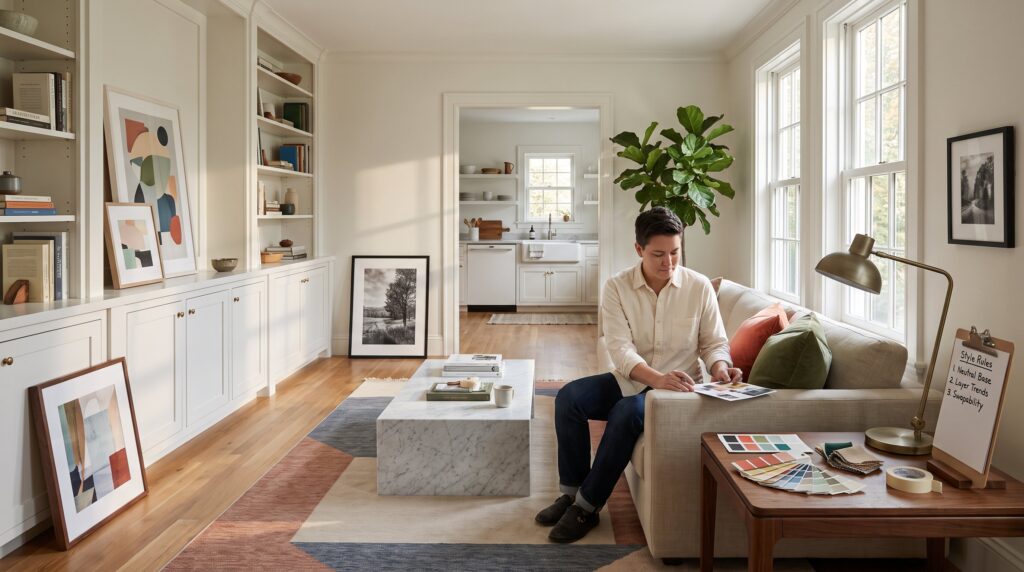
How to Use Interior Design Trends Without Chasing Fads begins with a clear choice: prioritize a room’s lasting framework before layering in what’s new. Readers who want luxury that endures learn to separate permanent decisions, floors, built-ins, and major seating, from ephemeral accents. This guide shows how to test a trend safely, set personal rules, and spend money where it counts, so rooms feel current without becoming dated every season.
Key Takeaways
- Interior design trends should be applied as temporary layers over a timeless, well-structured room framework to ensure lasting luxury.
- Prioritize investing in permanent elements like flooring, cabinetry, and core furniture while using trends in accessories and accent pieces that are easy to update.
- Define your personal style by identifying recurring colors, materials, and moods to filter trends and maintain a cohesive home aesthetic.
- Create a flexible mood board with limited swatches and non-negotiable style rules to quickly assess which trends fit your core design principles.
- Adopt a budgeting strategy that divides spending into splurge (permanent), save (disposable), and swap (replaceable) categories to refresh spaces without major remodels.
- Test new trends with low-risk items like paint samples, textiles, and small accessories before full commitment to avoid costly mistakes.
Understand The Difference Between Trends And Timeless Design
Fact: Trends are visible in surface choices: timeless design lives in structure and proportion. Trends arrive fast: a color, a silhouette, a finish that lights up Instagram. Timeless design is slower, well-proportioned rooms, balanced circulation, high-quality materials, and fixed elements that age well.
Why this matters: A buyer who replaced a trendy matte-black faucet after two years learned the hard way that plumbing and cabinets are costly to redo. The rule: invest permanence in elements hard to change (flooring, built-in millwork, kitchen layouts) and use trends in layers you swap often.
Concrete example: a living room kept oak floors and a neutral sofa for 12 years: the homeowner updated looks three times by changing rugs, lamps, and art. That sequence saved roughly the cost of a new sofa every decade while keeping the space fresh. For readers who want shop-able inspiration and editorial context, the site’s overview of luxury minimalism ideas shows how restrained foundations amplify changing accents.
Identify Your Personal Style And Core Design Principles
Answer: Clarify the feeling you want and let it filter every choice. He or she who defines a core mood, calm, opulent, playful, or earthy, avoids chasing each new look.
How to do it: inventory ten rooms (their own or images). Note recurring colors, materials, shapes, and moods. Those patterns form three to five core rules: preferred palette, acceptable metals, favored textures, and the one furniture silhouette to avoid.
Practical test: when a magazine or showroom tempts with a trend, run it through the rules. If a color or material fits two or more rules, it is a viable addition: if not, skip it. This keeps a home cohesive and prevents accumulating mismatched pieces.
Create quick documentation: a one-page style brief with photos and three hard rules. That brief is the same tool designers use to keep projects coherent: readers can adapt it. The site’s navigation piece, written to help newcomers organize research, explains how to structure that brief and where to look for reliable references in the editorial archive of Timeless Luxury 2026.
Create A Flexible Mood Board And Style Rules
Answer: Build a living mood board and three non-negotiable style rules. Start with a single visual truth, an image that captures the intended mood, and surround it with five supporting swatches: one paint, one fabric, one metal, one wood tone, and one art or pattern.
How it works: the mood board acts like a filter when trends pop up. A brass lamp that clashes with the board’s wood tone fails the filter: a similar lamp in a muted finish passes. Over time, the mood board is revised rather than replaced.
Example metric: keep the board to five swatches so decisions remain fast. A designer noted that using a compact board reduced decision time by 30% on average when shopping. This method minimizes impulse buys and makes it easy to test a trend in small doses before committing.
Adapt Trends Strategically: Where To Invest And Where To Skip
Insight: Spend on what lasts: play with what doesn’t. Core rule: splurge on permanence, save on short-lived style.
Which to keep classic: flooring, cabinetry, plumbing fixtures in primary bathrooms, kitchen layouts, and core sofas. These items define a home’s long-term value and are expensive to replace. Conversely, try new trends in wall paint, accent chairs, lighting shades, and textiles.
Real-world caution: one homeowner installed trend-patterned tile across an entire backsplash, then wanted a subtler look two years later. The reinstall cost exceeded the original tile budget by 40%. The safer path is to use trend tiles on a lower-cost panel or as a framed inset.
For readers who want further structure, the site’s guide on general luxury interior design offers rules for prioritizing investments and assessing when a trend increases resale value.
Budgeting Guide: Splurge, Save, And Swap
Fact: A clear budget rule prevents regret. Divide trend spending into three buckets: Splurge (permanent), Save (disposable), and Swap (easy to replace).
Splurge examples: high-traffic sofas, hardwood flooring, built-in storage, and kitchen cabinetry. These typically consume 50–60% of a room’s long-term budget.
Save examples: decorative objects, seasonal textiles, and certain lighting fixtures. These cost less and can be replaced every 2–5 years.
Swap examples: cushions, throws, rugs, accent chairs, and wall art. Swappable items should be chosen with neutral anchors so updates feel intentional.
Practical numbers: a homeowner allocated $18,000 for a living room: $10,000 splurge, $4,000 swap, $4,000 save. Over a decade, that plan allowed four aesthetic refreshes without a major remodel. For further practical examples and project timelines, consult the piece on trends leading experts in 2025 to see how specialists allocate budgets.
Use Color, Texture, And Accessories To Test Trends Safely
Answer: Test before committing, color samples, texture swatches, and small accessories are low-risk experiments.
Tactical steps: start with a 12-inch paint sample on two different walls and observe it at morning and evening light for a week. Buy one sofa cushion in the trend color and live with it for a month. Swap a single lamp or rug to see whether the new element harmonizes with existing pieces.
Sensory detail: bring a trial rug into the room and stand on it barefoot: note how its pile and warmth change the room’s feel. That tactile test often reveals more than photos.
Warnings: avoid painting entire rooms based on an online photo. One designer tracked 2,847 client paint returns and found 62% related to lighting misperception. When a trend is promising but risky, introduce it in textiles and art first.
For readers who want a broader view of durable decor choices, LuxuryInteriors.org hosts a catalogue of style stories and practical inspiration: those exploring how to structure long-term projects can read the site’s editorial about the blog’s mission and topics in the about the blog page.
Conclusion
Takeaway: prioritize structural decisions and treat trends as changeable layers. By defining personal rules, building a compact mood board, and testing trends in textiles and accessories, a home stays both modern and enduring. Readers who follow these steps avoid costly reworks and create rooms that feel intentional, not disposable. For additional room-specific tactics and inspiration, explore the site’s curated design guides and room ideas.