
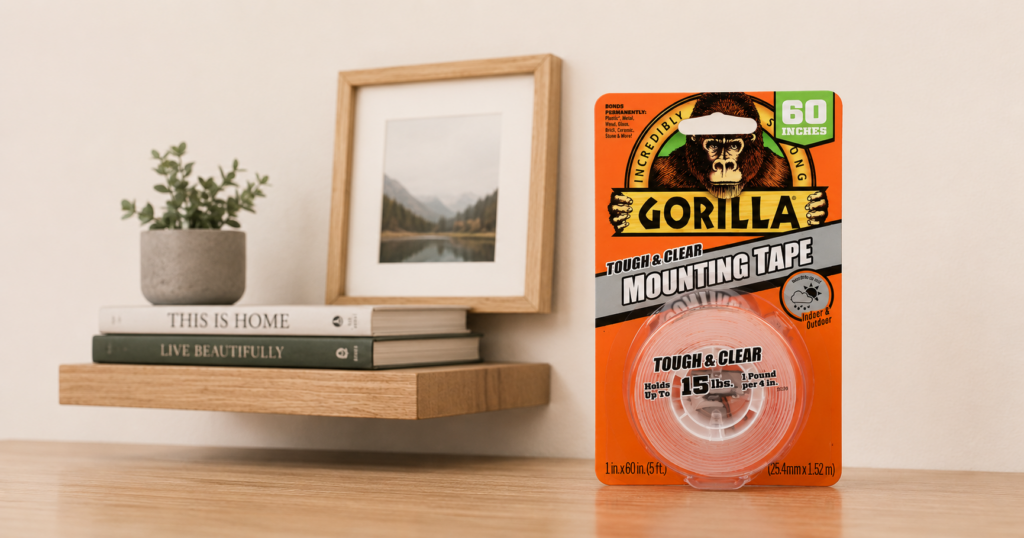
“How much weight can this actually hold?” is the first question everyone asks about mounting tape, and it’s also the hardest one to answer with a single number. Manufacturers publish figures, sure, but those numbers assume a clean, smooth, properly prepped surface and a full cure time before anything gets hung. Real walls, real shelves, and real impatience rarely match the lab conditions the number was tested under. Rather than chasing one magic figure, it helps to understand what actually determines how much a strip of double-sided mounting tape can carry, and where the line sits between “perfect for this” and “please just use a screw.”
Why There’s No Single Weight Answer
Holding strength depends on far more than the tape itself. The surface it’s stuck to matters enormously, since smooth painted drywall behaves nothing like textured render, brick, or wallpaper. The size of the tape matters too, because holding strength scales with contact area, so a small square holds a lot less than a long strip running the full width of a shelf bracket. How long the tape has had to cure before you load it changes things again, since most mounting tapes build strength over the first 24 to 72 hours rather than hitting full strength the moment you press them on. Even room temperature plays a role, as adhesives generally bond better in mild conditions than in extreme heat or cold.
What Actually Determines Holding Strength
Surface texture and cleanliness sit right at the top of the list. Dust, grease, or a chalky painted finish will quietly cut a tape’s grip regardless of what the packaging promises. Bonding area comes next, and it’s the part most people underestimate, because doubling the length of tape roughly doubles the contact area and therefore the load it can realistically carry. Cure time is the one people skip most often. Hanging something the moment the tape goes up, before it’s had a chance to bond fully, is one of the most common reasons mounting tape gets blamed for a failure it didn’t really cause. Weight distribution matters as well. A picture frame pulling straight down is a very different load to a hook holding a bag that swings and tugs at an angle.
Realistic Weight Guidelines by Job
For light décor like small frames, artwork, or lightweight signage, a good mounting tape square or strip will generally hold a few kilograms without issue, assuming the wall surface is clean and smooth. For hooks and organisers carrying keys, small tools, or bags, heavy-duty mounting tape can often manage several kilograms per strip, though it’s worth spreading the load across more than one strip if the item is wider than a few centimetres. For anything approaching shelving with real weight on it, books, kitchen items, anything with genuine mass, mounting tape becomes a supplement to proper fixings rather than a replacement for them. It’s excellent at holding light, flat, low-movement items securely. It was never meant to carry furniture-level loads on its own.
Getting the Most Out of Mounting Tape
Clean the surface properly first, since even a light film of dust or grease can cut holding strength significantly. Press firmly along the entire length of the tape rather than just tapping the middle, because full contact is what actually creates the bond. Wait the full recommended cure time before hanging anything, even if the tape feels solid to the touch straight away, since it isn’t. And for anything heavier or wider, use two or three shorter strips instead of one long one, since multiple contact points spread the load and reduce the chance of a single edge peeling under strain.
Surface Type Changes Everything
Painted drywall in good condition is about as forgiving as it gets, provided the paint itself is fully cured and not freshly applied. Tile, glass, and metal are non-porous and generally bond even better than painted plaster, since there’s a smooth, consistent surface for the adhesive to grip rather than a slightly uneven, absorbent one. Textured render, brick, and raw plaster are the trickiest of the bunch, because the tape only really contacts the high points of the texture, which shrinks the effective bonding area even though the strip looks the same size. Wallpaper deserves its own warning altogether, since the tape may bond just fine to the paper itself while the paper’s own bond to the wall underneath gives way instead, and at that point the tape isn’t the problem.
When to Reach for a Screw Instead
Mounting tape is brilliant for the jobs it’s designed for, quick, damage-free, and genuinely strong within its limits. But for anything top-heavy, anything holding weight at an angle, or anything where failure would actually matter, like a TV bracket, a heavy mirror, or a shelf loaded with books, screws and proper fixings are still the right call. Knowing where that line sits is really the whole trick to using mounting tape well.
A simple gut check helps here. If the item falling would just be annoying, a scratch on the floor or a frame needing rehanging, tape is a perfectly reasonable choice once you’ve prepped the surface properly. If it falling would actually be dangerous or expensive, a TV, a heavy shelf above a bed, anything near head height with real mass behind it, that’s the line where a couple of screws are worth the extra ten minutes and the small hole they leave behind.