
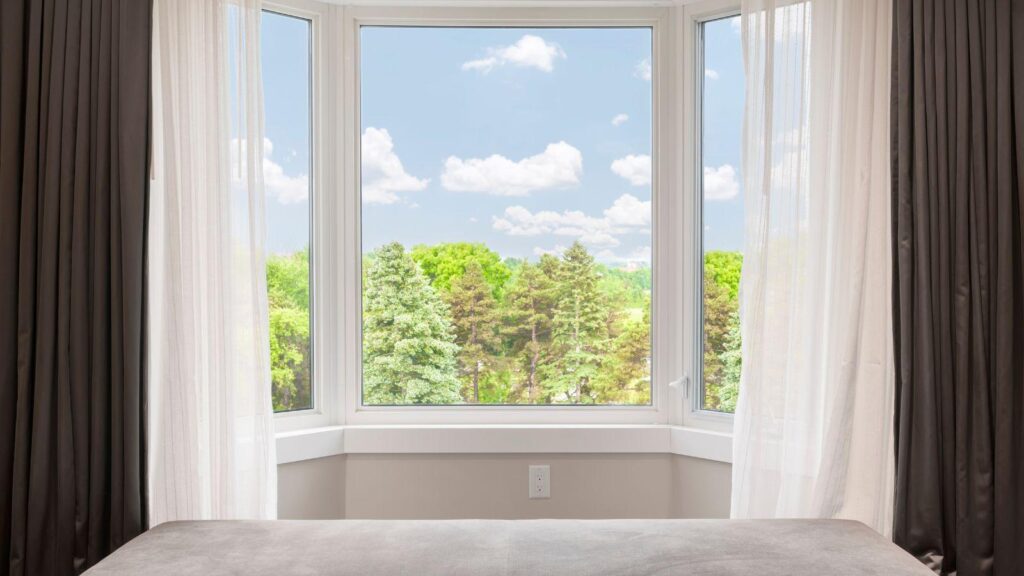
A bay window is one of the few architectural gestures that still earns its keep in a modern home. It pushes the room outward, pulls in light from three directions, and creates a pocket of space that begs to be furnished. Then someone hangs the wrong shades on it, and all that geometry disappears behind a row of clunky headrails.
I ran this problem past a designer at Covers Canada, a London, Ontario window treatment store that has been fabricating custom drapery and fitting blinds since the late eighties. Her diagnosis was refreshingly unsentimental: most bay window treatments fail before anyone chooses a fabric. They fail at the corners.
The corner problem
Every window covering has a header — the housing at the top that holds the mechanism. On a flat wall, nobody notices it. In a bay, each panel of glass meets the next at an angle, usually 45 or 135 degrees, and every header has to stop short of that joint. The deeper the header, the wider the gap it leaves.
Multiply that across three or five windows and you get a treatment that reads as a series of disconnected boxes rather than a single, continuous surface. Light leaks through the seams at night. During the day, the eye catches on every interruption.
So the first rule is mechanical rather than aesthetic: in a bay, the shallowest header wins. Choose the system that tucks closest to the glass, and the design decisions afterward get much easier.
Three questions before you shop
The designer’s advice was to settle these before looking at a single swatch.
Which room is the bay in? A family room bay can carry something loose and informal — a simple shade with unlined panels breaking at the sides. A kitchen bay usually wants shutters or something equally crisp, because the space is already busy and the treatment needs to hold still. A bedroom bay is the only case where you should be thinking about blackout from the outset.
What else is hanging in the room — and in the room next to it? Window coverings visible from an adjoining space should relate to each other. That doesn’t mean identical. It means a shared logic: the same colour family, the same operating style, or the same level of formality. Mismatched systems in one sightline are the single most common way a well-furnished room starts to look assembled rather than designed.
Is there furniture in the bay? Bays invite banquettes, breakfast tables, and desks. That’s their whole appeal. But whatever sits in the alcove is competing with the window for attention, and the window should generally lose gracefully rather than fight. If there’s a table close to the glass, keep the covering flat and quiet. Full drapery in a bay only works when you have the floor clearance for it to hang properly — a panel that stacks onto a bench seat looks like an accident.
Six treatments that actually work in a bay
Shutters. The most architectural answer, and often the most expensive. Shutters read as part of the window rather than something applied to it, especially when the frame colour matches or deliberately contrasts with the casing. They also solve the corner problem outright, since each panel is built to its own opening. Best in kitchens, offices, and any bay where you want the treatment to disappear into the millwork.
Honeycomb and cellular shades. These have the slimmest headrails on the market, which makes them the default recommendation for tight angles. The cellular structure also traps air, so they’re the strongest performer if your bay runs cold — and bays often do, being glass on three sides with minimal insulated wall between them. Quiet, unfussy, and they don’t compete with the geometry.
Hunter Douglas Duette shades. A cellular product that sits unusually close to the glass. Worth naming separately because the mounting depth is what makes it work here, not the fabric. If your bay has shallow reveals, this is the one to price out first.
Hunter Douglas Silhouette shades. Fabric vanes suspended between two sheer layers. Tilt them open and you get filtered light with daytime privacy; close them and the room softens considerably. There’s a blackout backing option if the bay is in a bedroom and you need the light control without giving up the look during the day.
Hunter Douglas Vignette shades. A Roman shade without the exposed cords — clean horizontal folds, wide fabric selection. This is the choice when you want texture and softness but the bay can’t accommodate drapery. Particularly good in bedrooms and reading nooks.
Sheer or unlined drapery. The most forgiving option visually, and the one most likely to fail practically. Lightweight panels move with the light and flatter a bay’s proportions in a way hard treatments can’t. But they need floor space to stack, and they need the alcove to be relatively clear. A formal sheer, an unlined linen, a patterned Victorian panel on a period bay — all beautiful, all dependent on having somewhere for the fabric to go.
Layering, if the budget allows
The most successful bays I’ve seen use two systems, not one. A shallow shade handles light and privacy at the glass; drapery panels sit at the outer edges of the bay, on the flat wall, framing the whole alcove rather than each individual window. The panels rarely close. Their job is to soften the transition between the bay and the room and to give the eye somewhere to rest.
This approach also sidesteps the corner problem entirely, because the soft treatment never has to negotiate an angle.
The part worth paying for
Bay windows are almost never square, almost never symmetrical, and almost never the angle the drawings claimed. Measurement is the whole game. The difference between a bay that looks tailored and one that looks approximate comes down to a fabricator who measures each opening individually and builds to those numbers.
If you’re working with a local supplier, ask whether they manufacture in-house and whether they measure on site. Covers Canada, for instance, produces its drapery in Ontario and sends designers out to measure — which is the kind of arrangement that tends to matter more in a bay than anywhere else in the house.
Get the header depth right, get the angles measured properly, and the bay does what it was built to do: hold the light and give the room somewhere to open up.