
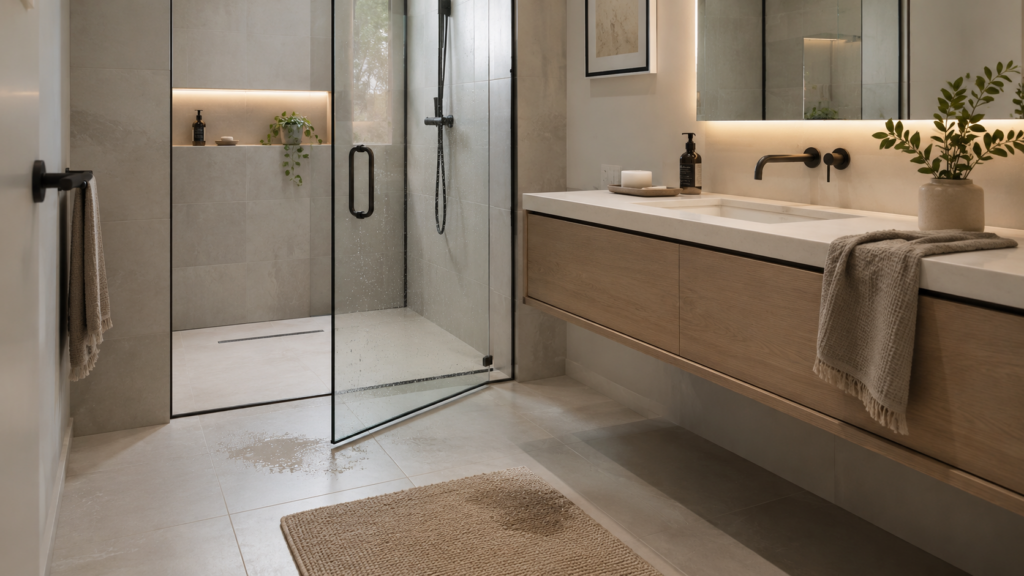
Some bathroom problems almost never appear on a design drawing.
In a render, the glass door is spotless. There is no water on the floor. The vanity is not covered with toothbrushes, cleanser, moisturiser or a hairdryer. Clean lines can make it easy to assume the room will be just as easy to live with.
Then you move in, and the details begin to show. You open the shower door and water lands by your feet. The niche looks beautiful, but the bottles you use every day do not quite fit. The mirror light feels soft in the photograph, but on a rushed morning, it is just a little too dim.
That is often where minimalist bathrooms become less effortless than they first looked. Not in the design you notice straight away, but in the practical details that have been hidden a little too well.
Picture an ordinary morning, not a finished-room photograph
A newly finished bathroom is usually easy to love. The vanity is clear, the towels are folded, there is not a drop on the glass, and even the slippers seem to be in the right place.
A normal morning at home is different. Someone steps out of the shower in a hurry. Someone else is trying to find the right light at the mirror. Another person is brushing their teeth while pulling open a drawer. The hairdryer cable ends up across the worktop, skincare is left beside the basin, and the damp towel does not always make it back to the perfect hook.
I once looked over a friend’s bathroom plan and thought it was beautiful at first glance. Frameless glass, a floating vanity, pale large-format tiles — all very calm and quiet. Then she said, “But if I have to wipe the floor outside the shower every time, that will drive me mad.” That one comment brought the whole design back into real life.
A bathroom does not prove itself when everything is still. It proves itself when someone is running late, their hands are wet, and the light is not fully on yet.
The problem is not always too much water, but water in the wrong place
Frameless glass works well in a minimalist bathroom. It feels light, clear and unobtrusive, especially in a smaller room where you do not want the shower to break up the space. The problem is that glass can look almost invisible, but water still needs somewhere to go.
Often, the issue is not a dramatic leak. It is a small, irritating damp patch. You push open the shower door, and water runs down from the bottom edge and lands by your feet. The bath mat starts out dry, then one corner is wet after a couple of uses. The next person into the room has to step around the same little area again.
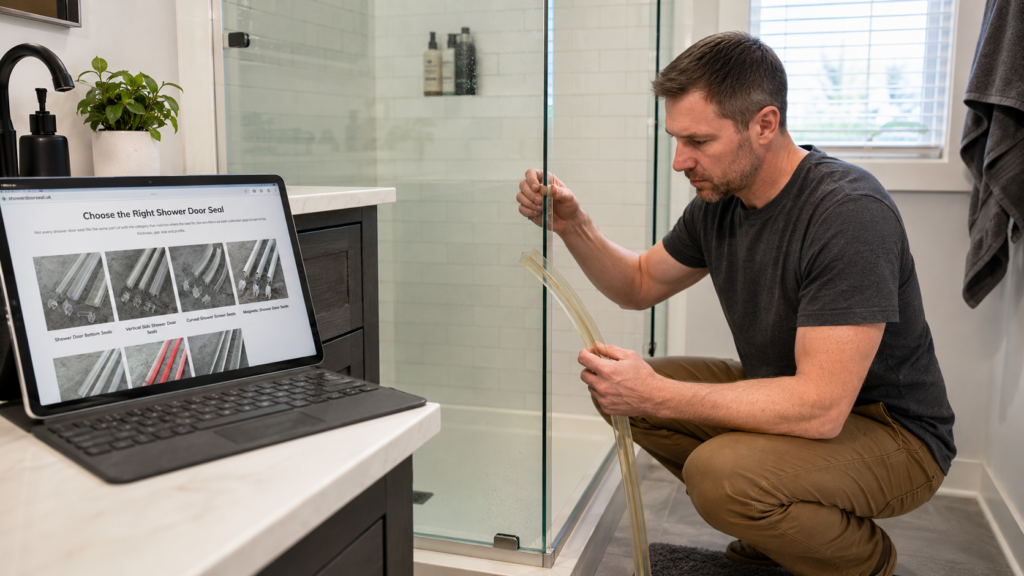
Another bath mat rarely solves that properly. With a frameless or semi-frameless screen, the small checks matter before it is fitted: glass thickness, the gap beneath the door, the side opening, and the right sealing strip for shower screen. These details decide whether water stays inside the shower area or is carried out onto the floor every day.
The part people often miss is fit. A seal that is the wrong size or shape can stop the door closing neatly, or make the glass line feel heavier than it should. In a pared-back bathroom, a practical detail still needs to be there. It simply should not take over visually.
A clear vanity looks good, but everything still needs somewhere to go
Many people are drawn to minimalist bathrooms because the vanity looks so clean. No rows of bottles, no tangled cables, no skincare sitting out where it does not belong. But a home bathroom is not a hotel room. Things do not disappear by themselves.
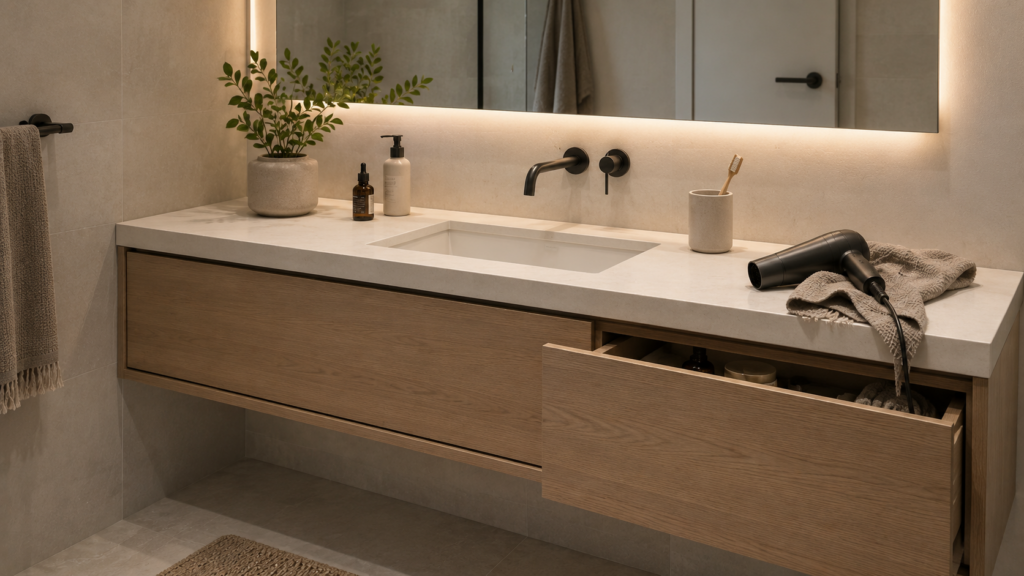
The real annoyance is not always having too much stuff. It is when everything is just slightly awkward to use. The shampoo is a stretch away from the shower. The hairdryer has nowhere obvious to land. Everyday skincare comes out in the morning, then feels like too much effort to put back into a deep cabinet at night. After a few days, the worktop starts looking like real life again.
I used to be drawn to an empty vanity too. Then I realised that the bathrooms which stay tidy are not usually owned by people with fewer things. They simply have better places for those things to go. Drawer depth, internal dividers and socket positions can make more difference than how flat the cabinet doors look.
The most comfortable kind of minimalist storage is not storage that hides things so well you forget where they are. It is storage that makes putting things back feel almost automatic.
Lighting that photographs well is not always useful at 7am
Lighting in minimalist bathrooms can look lovely. A backlit mirror softens the wall, and a hidden strip light can make stone or tile texture feel more refined. In a photograph, that sort of light is very appealing. At the mirror first thing in the morning, it can feel rather different.
When shaving, you may find yourself leaning closer to the glass. When putting on make-up, you might step towards the window to check the colour. After a shower, you may want to see whether your hair has rinsed properly, only to realise the mirror light is better at creating atmosphere than helping you see clearly. At night, if the only option is one bright ceiling light, it can wake you up more than you would like.
There does not need to be more lighting for the sake of it, but the placement has to work. The mirror needs clear, even light. The shower area should not feel gloomy. A low-level night light can be far more useful than a single harsh switch. The fittings can stay discreet, but the light itself should not make daily routines harder.
Long-term maintenance depends on whether small parts are easy to replace
When a frameless shower door is first fitted, people usually look at whether the glass is clear enough and whether the hardware colour matches. A few years later, the part causing the most frustration may be a hardened bottom seal or a side strip that has started to loosen.
The glass may still be fine. The hinges may still work. But after a shower, water starts escaping from the same place again. Then comes the awkward bit: can the old seal be pulled off easily? Does the hardware get in the way? Is the gap under the door even? Two strips may look similar, but one is for the bottom of a door, another for the side. One uses a soft fin to hold back water; another simply grips the glass edge. Choose the wrong one and the door may not close properly, or the water may still escape.
I used to think shower door parts were much the same. After helping people compare them a few times, I realised the hardest part of maintenance is often not deciding to replace something, but knowing what to replace it with. A good frameless shower door should not only look smart on installation day. A few years later, it should still be possible to remove the worn part, compare it clearly and find a suitable replacement.
Manufacturers such as SIMBA Seals, established in 1998, have spent years making shower seals and now offer more than 9,000 styles. Their retail site, showerdoorseal.uk, guides households by glass thickness, fitting position, gap size and seal shape, so people are not left guessing from one old strip and a quick photo.
A good minimalist bathroom should not keep asking for fixes
A good minimalist bathroom should not become a room where you are always adding something to make it work.
There should not be a second bath mat permanently outside the shower. The vanity should not refill itself every morning. You should not have to switch on a harsh overhead light at night, or dread cleaning the same glass edge every week.
The room can still look calm and restrained, but not because the useful parts have been removed. They should already be in the right places, working quietly. A comfortable bathroom does not keep reminding you that something needs adjusting. It simply makes washing, getting ready and leaving the room feel that little bit easier.